
Skip to content
Eirich
Correspondence

Plate I · Volume II

The Intensive
Mixer.

§ Mixing system No. 1.

One patented encounter between a pan and a tool, both turning, both governed by the operator. From this single short paragraph the entire house has drawn one hundred and sixty three years of work.

Apparatus

A single drawing,
five variants, seven processes.

Patent
1903
Range
0.1 L to 12,000 L
Tip speed
up to 40 m/s
Vacuum
down to 10 mbar
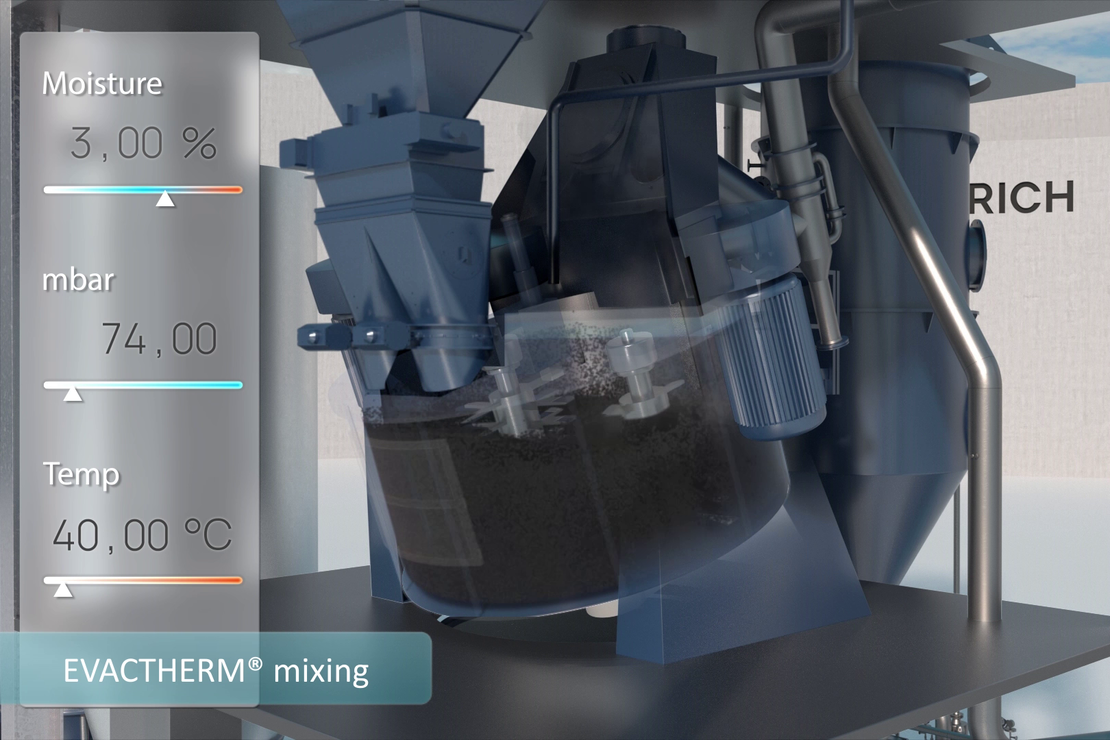
The Eirich Evactherm intensive mixer photographed for plate I

Plate I

An intensive mixer, photographed at Hardheim.

The pan rotates clockwise, the eccentric tool rotates against it. Two motors, two consoles, one trained operator at the rail.

§ Principle

The principle,
in four notes.

A short essay on which the entire apparatus rests.

§ I

Rotation

A pan that turns one way and a mixing tool that turns the other. Two independent motors, two independent speeds, one carefully governed encounter at the wall of the chamber. The geometry is patented, the principle is one hundred and twenty three years old, and the answer it gives is repeatable.

§ II

Energy

Tip speed up to forty metres per second. Energy is dialled by the operator at the console, not pinned by the cast iron of the housing. The same machine kneads a stiff plastic dough at midnight and disperses a watery slurry at dawn.

§ III

Scale

The same drawing resolves from one tenth of a litre on the laboratory bench to twelve thousand litres on the production floor. Recipes do not change with the machine. A protocol from the Technikum survives the move to the gigafactory hall.

§ IV

Vacuum

A sealed housing down to ten millibar. Oxidation, moisture and stray dust are excluded at the source. The Evactherm variant cools, dries and mixes inside the same chamber, in a single recipe step.

§ Sizes

From the bench
to the hall.

Three size bands, one drawing. The recipe written for a tenth of a litre survives unchanged at twelve thousand. This is the most expensive sentence the house has ever written, and the most useful.

§ Laboratory

0.1 L to 5 L

first trials, formulation, doctoral work

§ Small scale

40 L to 150 L

pilot production and the bridging of recipes

§ Large scale

250 L to 12,000 L

production halls, gigafactory cathode lines, foundry sand circuits

§ Variants

Five
configurations.

§ Standard
fixed pan, tool from above, the textbook configuration
§ Hinged
pan opens for fast cleaning between recipes
§ Tilting
pan tilts for full discharge of plastic and pasty bodies
§ MixSolver
the dissolving variant, for high shear into liquid
§ Evactherm
vacuum cooling, drying and mixing in one chamber

§ Processes

Seven
capabilities.

One chamber, seven distinct processes. Each one is logged in the protocol, each one is reachable from the same console.

I. Mixing
II. Granulating
III. Kneading
IV. Dispersing
V. Coating
VI. Drying
VII. Vacuum mixing

§ Applications

Industries
at the door.

The intensive mixer answers the same question for a battery cathode line and a foundry sand circuit. Different feeds, the same patient encounter at the wall of the pan.

§ Heavy industry

  • Foundry sand
  • Refractory
  • Concrete
  • Dry mortar and plaster
  • Sand lime brick

§ Energy

  • Lithium ion batteries
  • Lead acid batteries
  • Carbon paste
  • Friction linings

§ Materials

  • Ceramics
  • Glass
  • Metallurgy
  • Fertiliser
  • Environmental technology

Colophon · Plate I

Bring the material.
We will mix it.

A sample of your own feedstock, run on the exact machine you would buy, four to six weeks from arrival to a signed protocol.

Write to Hardheim